Showing posts with label Research and Enquiry. Show all posts

Thursday, 5 January 2012

Studying balance and action

The head is shaped first, the line of action is coming from the top of the head, going down to the right leg's toes. the secondary line of action, the flow line, is marked from the top all the way down to the other arm behind her.
The secondary flow line starts from her back and comes down to the other leg, as she's leaning forward to catch her weight.
The way to find the center of balance is to draw a straight vertical line that starts in the middle of the neck all the way down to her legs.


Balance and movement go hand-in-hand: the body is constantly adjusting in order to maintain balance and if we are moving forward our weight will be shifted forward. This is the reason why while drawing we need to keep in mind the concepts of balance and action in order to make more realistic sketches.


Reference: Digital Tutors

Monday, 2 January 2012

Examining some principles of animation in "Luxo Jr."

After watching Luxo Jr several times, I decided to examine and find out how John Lasseter applied the principles of animation and made his short film so successful.

Squash and Stretch:
Luxo Jr squashes and stretches differently, it does not deform. To squash, Luxo folds over on itself, and to stretch, it extends out fully.

Timing:
The two characters in Luxo Jr do not rely on speaking to convey their emotions, but on movement alone. If one action is missed, then the audience would miss an emotion.  Therefore, the animator spent enough time on the anticipation of an action; the action itself; and the reaction to the action, to make sure he catches the audience’s attention at every second of the short.

Anticipation:
In the beginning of Luxo Jr., Dad is on screen looking offstage. Then, he reacts to anticipate something that is going to happen next. When Junior appears, the audience is prepared for the action.

Staging:
Most of the times when Junior was on screen, Dad was barely doing any actions. The reason for that is to keep the audience’s attention on Junior, because the story is mainly about him. The two characters do not do any important action at the same time. For example, after Junior kicked the ball, he looks at Dad, when Dad shakes his head; he gets all the audience’s attention.

Slow in and out:
Junior’s base was heavy, when he jumped, it had to stay inactive then quickly arise in the air from the momentum of his jump, arc over, then land suddenly motionless again.

Exaggeration:
The design of the lamps was based on the real Luxo lamp, but Jr.’s proportions were exaggerated to make him look like a child.
Even though all the movements seemed like natural physics, yet almost every action was exaggerated to emphasise it.

Secondary Action:
When the base hops, Luxo Jr.’s cord moves.

Appeal:
It was achieved in many ways, especially in designing characters. The appeal effect was attained using exaggeration in proportion of Jr.

Personality:
Jr. was very happy and enthusiastic when he was chasing the ball. His jumps are very fast because he can’t wait to get to the ball. When he pops the ball, his jumps change radically to reveal his sadness.


Sunday, 1 January 2012

Animation, is it only for children?


I believe that it is not the genre of the movie that attracts audience, but rather the plot, the character and the story. We go to movies or rent a DVD because we want to be entertained, we want to laugh or be thrilled and most importantly we want our whole mind to be taken by what we are watching. So it is not an animated character or a human actor that attract us, but it is what they say, how they say it and what their story is.
I, as a young adult, laughed when I watched Ice Age as much as I did when I watched any other comedy with live actors. I cried when Mufasa in the Lion King died as much as I did when Satine died in Moulin Rouge. Children laugh because of how characters move in an animated movie, because of the sounds they make and the expressions on their face. But adults understand the jokes better. I, and most people I believe, understand better the jokes in Tom and Jerry now than we did when we were children. Adults understand the jokes in animated movies whereas children are amused by the funny characters.

The following website explains that animated movies such as Up, How to Train Your Dragon, WALL-E from Pixar and DreamWorks have proven that animation has a lot to offer viewers of all ages. And a woman, Julia Alekseyeva also wrote in this article that as an audience, we are also finally beginning to accept the fact that something like animation—often associated with kids—isn’t a genre, but a medium.

Successful animators are behind this change in audience’s view of animated movies. They seem to be driven by the belief that animated movies are not solely for the entertainment of children, but also adults. For instance, John Lasseter and Brad Bird, two old classmates, believe that animation could amount to more than the children's fare it had become. They have tailored their animated movies to the preferences of adults and children, to entertain both and win them as faithful spectators.

However, some stubborn viewers still believe that animation is just for children despite the strides it has made in recent years. This prejudice can only be overcome when those people decide to step into a movie theatre to watch an animated movie with an open mind willing to be amused.

Thursday, 29 December 2011

Interior lighting in Mental Ray

Before starting to light an interior scene, I decided to go through some artists and painters who examined the concept of shadow and light. I checked Michalangelo Caravaggio's work (while he was exploring chiaroscuro), where he highly contrasted areas of light and shadows. 

How the work was done:
I started by overriding the material with a white one then started the lighting process. My light source was the sun coming from the window. I used Skyportal (mr. Sun and mr. Sky. mySkyportal put on the window).
To test the lighting , I saved the final gather map and loaded each time so that the render takes less time. Photometric lights (with added .ies files) are located at the roof. I used an average of 3000 Kelvin intensity (warm), to indicate that’s the scene is captured during almost an afternoon. When the sun’s down. 
For the materials, I textured most of the models with Arch & Design.


Some snapshots of the work:


Test renders:


Saturday, 24 December 2011

Short study on "Finding Nemo"


Humans respond to facial expressions and have the ability to create and decode anthropomorphic characters as a mean of communication (the smiley face for example). To serve the storytelling function of the characters in "Finding Nemo", the designers modified the position and shape of the eyes and gave the characters flexible lips.

The animators at Pixar were committed to achieve realism in their animations, research played a crucial part: studies were done on various dissected fish and whales, to better understand the anatomy of aquatic creatures, help from underwater life experts was provided and software tools were created for water simulations.

One of the issues that were faced, the realism of the environment made the animated character appear out of context in the test footage, which forced the technical team to recreate the environment so it wouldn't look so photorealistic. This brings to mind, the "Uncanny Valley", which is a hypothesis state (first proposed by Masahiro Mori, 1970) in robotics and was later applied in 3D animations, it states that realism (characters and animations) will be more appealing to viewer but within a certain limit that if exceeded will cause the viewers to reject what is presented.

Also it is important to note that characters function properly if presented in a certain context where every element must be part of a unified design that serve the story otherwise it would seem out of place (Withrow S. 2009) , like placing animated talking fish in a photorealistic environment. 


Sunday, 18 December 2011

Examining some principles of animation in "The Adventures of Andre and Wally B."

After watching “The Adventures of Andre and Wally B.” many times, I decided to study how John Lasseter applied the principles of animation to make it successful.


Anticipation:
In one of the short film’s shots, Wally B. goes quickly to the right. The actual action is only about 4 frames long, but he anticipates his move for a certain time - enough for the audience to know exactly what he is going to do next.

Staging:
When Andre wakes up, he scratches his side. Lasseter made sure that Andre doesn’t scratch his stomach - for example, because if he did, the action that happens in front of his body would be unclear to the audience.

Follow through and overlapping action:
This principle was widely used on Wally’s feet, stinger and antennae. They all continued to move even after his body stopped. Those three have different sizes and masses; therefore the follow through for each one of them was different: the antennae were light, so they slightly dragged behind. The stinger was heavier than the antennae, so it dragged behind the action more than the antennae. The feet were very heavy, so they always followed far behind the main action, with a lot of squash and stretch.

Secondary Action:
After the body’s main action, Wally B.’s feet drag. This is a secondary action because the movement of the feet is a straight consequence of the movement of the body.

Appeal:
When Andre wakes up and yawns, the yawn is very appealing: because the poses and actions are not duplicated on both sides of the body. His feet do not rotate similarly, the upper part of his body rotates to the right and slightly tilts, and that raises his right arm higher than his left. When he stretches his arms, the right arm translates first, then the left.


Wednesday, 14 December 2011

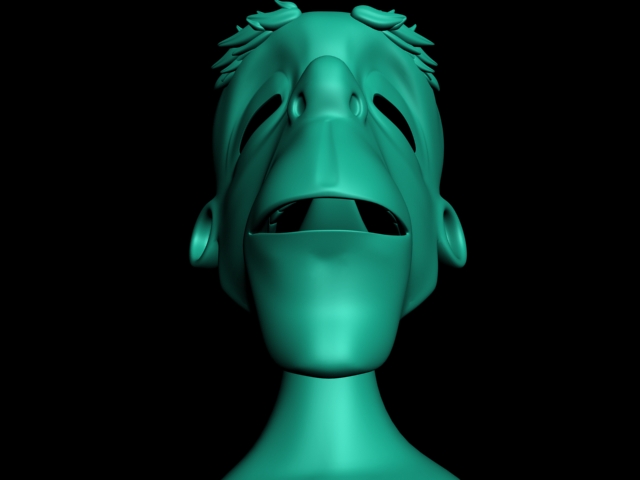
Modeling a cartoon character

Based on the Digital Tutors tutorial for "Creating Cartoon Characters in 3ds Max", I modelled my own crazy scientist: "Arthur".


Here are some snapshots of the work:


Testing:


Renders:


Morphing Arthur:

Monday, 12 December 2011

Principles of Traditional Animation Applied to 3D Computer Animation

For me, character animation doesn’t mean making an object look like a character or give it hands and a face. It is giving life to an object, make it look as if it was thinking and all of its movements are generated by its own thought process. It is the change of shape, facial expressions and body language that show that a character is thinking. It is giving the object a mind of its own to enable it to think, and thus create the illusion of life that comes from the ability to dictate your own movements and express emotions.  As Saint-Exupery once wrote, “It’s not the eyes, but the glance - not the lips, but the smile...”

“The eyes more than anything else give life to a toy” said Lasseter. “The angle of a blink, how far the pupils go off to the side when a character is trying to peek at something without being noticed, conveys a sense of presence better than any other element”. 

I realized that the ability to think and thus act accordingly gives life to objects. I was unaware that that was what I did in my projects to give life to the characters I created.


For example, in my last short-animation, even though the main characters were nothing but simple spheres, the audience would have the feel that the spheres are actually human. Even though they had no face, hands or feet, one could absolutely feel it when they are happy, sad, angry, etc. This was possible because the spheres were animated based on the principles of traditional animation.

Sunday, 11 December 2011

Animation: Science or Art?

I've been reading in Stuart Mealing's book "Computers and art". I found the first chapter very appealing, especially for a person like me that has a science background.

Mealing states that computer animation is a remarkable combination of Science and Art. He declares that animation represents one of the leading progression areas in computing and is defined to be a sequence of images in continuous movement. Its purpose may be entertainment, education, commercial persuasion or other.

The author asserts that computers have been of great assistance to the animation industry. He makes a sustained analysis of some of the ways that explain how the computer helps create better animations. He clearly explains that hand-drawn animation requires a lot of patience and is time-consuming because each frame is separately created by the illustrator. He then gives an example: “a feature film containing the production of 250,000 individual drawings would take fifty years of labour if all were to be drawn by one person [Halas 1974]”.

Mealing explains that computers  have replaced  people in doing monotonous tasks, especially the  specific repetitive chores involved in traditional animation.
In his first chapter, Mealing argues that computers can aid animation in two ways: as tools to develop the application of traditional methods; and as  means of producing output that could not be produced traditionally. It is possible that, the use of computers requires a smaller budget, less time to do the animation and has better precision than the traditional animation techniques: projects that were previously impossible to do can now be easily completed with the use of computers.

Stuart Mealing concludes that there are many ways that computers can support, complement or modernize traditional animation. For instance, the computer offers animators a new set of tools that would encourage them to push the boundaries of the discipline far forward, and allow work of unimagined complication and complexity to become an everyday reality.

Tuesday, 6 December 2011

Japanese animator Hayao Miyazaki


Lasseter was inspired by a Japanese animator/director, Hayao Miyazaki, that was able to entertain the whole audience, both adults and children, not just younger viewers. Miyazaki’s films: Castle of Cagliostro, My Neighbour Totoro, Princesses Monomoke –among others-, were very popular in Japan, mostly driven by the vision of a director that believed that “adults should not impose their vision of the world on children".

Many animators from Disney and Pixar (such as Glen Keane and Pete Docter) also admit that Miyazaki's work and his ability to entertain adults and children had a huge influence on their work.

I was surprised to read that American/European animators were inspired by a Japanese animator. With such differences in culture and context, I expected to find barriers for ideas to be exchanged and for beliefs to be transferred from one part of the world to the other. But it appears that I was wrong.
Miyazaki’s core belief that adults can enjoy animated movies applies to all cultures because human beings are not that different after all. We all want to be entertained.


My neighbour Totoro:


Totoro appears in Toy Story 3 , as a proof of Miyazaki's influence on John Lasseter:


Monday, 5 December 2011

Drawing an arm

Studying the body's anatomy is very necessary for animators. Hence I started checking some anatomy books to help me draw, model and sculpt a human body. with the help of Digital Tutors, I started drawing an arm.

                                                                               
 Studying the Arm's anatomy


Arm's form


Sketch


Saturday, 3 December 2011

Classic animation principles applied to convey emotion

John Lasseter explains that, if one needs to convey emotions, classical animation principles have to be applied. He demonstrates these principles in Pixar's first short-film Luxo Jr.- which he animated -. 
He did not focus on background, nor on the camera's animation. Instead, he was concerned about techniques based on classical animation.

His main concern was to add emotion to the characters that were faceless and wordless. The audience could feel when the child was joyful, and when he/she was sad. Both characters seemed to have a certain frame of mind at every moment of the scene.
Lasseter argues: "If the animator understood and applied the animation principles of Disney’s Nine Old Men, objects could engross audiences with their emotions, they could appear, indeed, more human than humans!"


I also noted Edwin Catmull’s comment  on the film in his book Computer Animation: A Whole New World  : " Luxo Jr. sent shock waves through the entire industry – to all corners of computer and traditional animation. At that time, most traditional artists were afraid of the computer. They did not realize that the computer was merely a different tool in the artist's kit but instead perceived it as a type of automation that might endanger their jobs. Luckily, this attitude changed dramatically in the early '80s with the use of personal computers in the home. The release of our Luxo Jr. ... reinforced this opinion turnaround within the professional community.”

Tuesday, 29 November 2011

Pixar's influences


Lasseter believed that it is conventional to examine other artists’ work to find inspiration in them. This belief was present in the Pixar culture, and seeped into the films they created. The team behind “Toy Story”, for example, was influenced by previous creations; American movies that dealt with friendship, such as “Raggedy Ann and Andy” (1977).
 We have the movie Ratatouille, were –in a pivotal scene– a restaurant critic is taken aback by an unsophisticated meal that is considered peasant food. The scene echoed, albeit in a comedic fashion, an incident in the book Remembrance of Things Past by Marcel Proust. Inspiration from Alfred Hitchcock’s Rear Windows can also be seen in two different Pixar movies. First one is Toy Story 2, where a character uses the camera flash for a weapon, and second is Ratatouille where  in the apartment vignettes witnessed by the star of Ratatouille.

Saturday, 26 November 2011

Ryan, the film

While reading the "Cyberarts 2004" book, I was inspired by Ryan Larkin's approach. Larkin was a  brilliant Canadian animator in the 1960s. Even though he was  addicted to drugs and alcohol and was mostly homeless, he was known for his unique ways of thinking and imagining,. In one of his interviews, he quotes Anais Nin :"We don't see things as they are. We see things as we are".


His third short animated film "Walking" (http://www.youtube.com/watch?v=9xK0wua5XVM&feature=player_embedded#!)  attracted the audience and was nominated for Academy awards.  

One how-to book on animation, Timing for Animation, goes on to say how Larkin’s female nude in "Walking" “makes good use of perspective animation through the exaggeration of the character’s arm nearest to the camera”. 

Chris Landreth (an animator who was Larkin's friend) made an Oscar winning 14 minutes animated documentary "Ryan" about his friend. I was personally impressed by the evident creativity that involved in Chris' documentary. His work is very unique and visually very interesting. I think that "Ryan" is not just a 3D-animated documentary, it's a piece of art, and its medium is computer animation. 

Ryan, the film:


Thursday, 24 November 2011

My field of study: Animation


Mickey Mouse, Tom and Jerry, Donald Duck, Peter Pan, and Pinocchio were all parts of my illusive world when I was a child. All these cartoon characters are the creation of the wonderful art of animation that captivates our minds and makes our childhood days full of imagination and fun. Animation represents the world that exists outside our regular lives. Not only is it a source of entertainment, but it has the power to influence. While I admired and respected the art, it was not until I read about Walt Disney’s history that I realized how much of a profound effect the Disney series made on popular culture.

I always thought that the greatest artists were animators, because they could influence the whole of society, from its youngest to its oldest members. Personally, animation was my anchor as I was growing up. In many ways, it instilled in me certain principles to live by. There was always a sense of courtesy, civility, and fair play as the fundamental message of many animated series.

Thus, I finished high school and decided to major in Computer Graphics & Animation. The reason I chose this major was my love for art, and my belief in the power of the image. I want to influence my Lebanese society; I want to make it think, and reason, through image. Animation can be one of the most significant and enjoyable activities for the society. It is an interesting combination of Science, Art, and Spirituality. For example, in order to make a simple walk cycle for a character, not only does the animator have to know the principles of animation and the use of computer software, but he/she should also use their knowledge about the body’s anatomy and the laws of physics in order to make a realistic movements. The power of a good animation should not be underestimated.
I am intrigued and mesmerized by the field and know of my creativity and capabilities which I can offer in  the world of animation. 

I aim to create a new world of communication based on imaging that will reach an audience, convey morals and values, and hopefully make a difference.

Sabine T.